
Child Marriage Worldwide : Millions of girls across the world are still being denied the freedom to decide their own futures. At an age when they should be attending school, developing skills and pursuing their dreams, many are being pushed into marriage and adult responsibilities.
According to UNICEF’s 2026 estimates, approximately 650 million women and girls alive today were married before their 18th birthday. More than 12 million girls enter marriage before adulthood every year, equivalent to roughly one girl every three seconds.
The figures, highlighted in UNICEF’s International Day of the Girl 2026 campaign, underline the continuing global challenge of child marriage despite decades of progress in education, gender equality and child protection.
UNICEF has warned that poverty, discrimination, harmful social norms and humanitarian crises continue to put millions of girls at risk of early marriage.
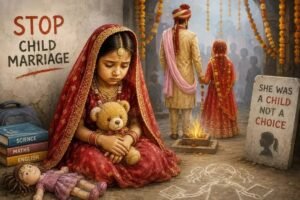
UNICEF 2026 Report: Key Child Marriage Statistics
| Indicator | UNICEF Estimate |
|---|---|
| Women and girls alive today who married before 18 | 650 million |
| Girls married before 18 every year | More than 12 million |
| Approximate frequency | One every 3 seconds |
| Child marriage prevalence in sub-Saharan Africa | 31% |
| Ever-partnered girls aged 15–19 who experienced partner violence | Around 23% |
| Child marriages averted worldwide in the past 25 years | 68 million |
These figures highlight both the scale of the problem and the progress made through education, legal reforms and social protection programmes.
Why Are Millions of Girls Still Being Married Before 18?
Child marriage is driven by several overlapping social and economic factors. Poverty remains a major cause, particularly in communities where families face financial insecurity and limited access to education.
Gender discrimination also plays an important role. In some communities, girls are expected to marry early, while boys are encouraged to continue their education or seek employment.
Traditional practices, concerns about girls’ safety, limited economic opportunities and displacement caused by conflict can further increase the risk of early marriage.
UNICEF considers child marriage a violation of children’s rights because it can restrict education, personal freedom, health and future economic opportunities.

Sub-Saharan Africa Has the Highest Child Marriage Prevalence
Sub-Saharan Africa continues to face some of the most serious challenges in eliminating child marriage.
UNICEF estimates that approximately 31% of young women in the region were married before reaching 18, compared with around 38% a decade earlier.
Although the decline represents progress, it has been slower than in South Asia.
Countries facing conflict, poverty, displacement and climate-related emergencies are particularly vulnerable. Population growth combined with slow reductions in child marriage could increase sub-Saharan Africa’s share of the global number of child brides in the coming years.
This makes investment in education, social protection and community-based prevention programmes especially important.
One in Four Partnered Adolescent Girls Has Experienced Violence
UNICEF’s findings also highlight the relationship between early marriage and violence against adolescent girls.
Globally, approximately 23% of girls aged 15 to 19 who have ever been married or partnered have experienced physical or sexual violence by an intimate partner at least once in their lifetime.
These experiences can have serious consequences for physical health, emotional well-being and personal safety.
Girls married at an early age may also face increased risks of interrupted education, early pregnancy, social isolation and financial dependence.
The violence estimate applies specifically to girls who have ever been married or partnered, not to all girls aged 15 to 19.
Two Major Challenges Facing Girls Aged 15 to 19
UNICEF has highlighted significant inequalities affecting adolescent girls, particularly in education and employment.
Girls aged 15 to 19 are twice as likely as boys of the same age to be outside education, employment or training.
The situation becomes even more difficult in conflict-affected and fragile settings. Girls living in these environments are nearly 90% more likely to be out of secondary school than those living in stable conditions.
Without access to education and economic opportunities, girls may become more vulnerable to child marriage and other forms of exploitation.
Child Marriage in India: Progress Made, but Challenges Remain
India has historically accounted for a substantial share of the world’s women and girls who were married during childhood.
However, the country has also recorded a significant decline in child marriage over the past two decades.
The figures cited in the supplied report indicate that child marriage prevalence declined from 47.4% in 2005–06 to approximately 20.1% in a more recent estimate. These figures should be matched with their original survey definitions and periods before publication.
UNICEF’s wider regional data show that South Asia has made substantial progress in reducing child marriage, although the region continues to have a large absolute number of women who married before adulthood.
Continued improvements will depend on keeping girls in school, enforcing child protection laws and addressing economic and social pressures that contribute to early marriage.
Boys Also Experience Child Marriage
Although girls are disproportionately affected, child marriage also occurs among boys.
The supplied report cites estimates of approximately 4% for boys in sub-Saharan Africa and 3% in South Asia who were married before turning 18, based on surveys of young adults.
These figures require verification against the original source and survey period.
Globally, UNICEF reports that child marriage is considerably more prevalent among girls than boys, reflecting persistent gender inequalities.
Can the World End Child Marriage by 2030?
In 2015, United Nations member states adopted the Sustainable Development Goals, including a commitment under Target 5.3 to eliminate harmful practices such as child, early and forced marriage by 2030.
Progress has been made, but the world remains off track to achieve the target.
UNICEF estimates that 68 million child marriages have been averted over the past 25 years through improvements in girls’ education, legal protections and social programmes.
The organisation has called for stronger action to ensure that girls can remain in school, access essential services and participate in decisions affecting their lives.
Education and Equal Opportunities Are Essential
Ending child marriage requires more than legal restrictions alone. Families and communities also need access to education, healthcare, financial support and reliable child protection systems.
Keeping girls in school, supporting vulnerable households and challenging discriminatory social expectations are among the measures identified by UNICEF.
The latest figures show that while progress is possible, millions of girls still face barriers to choosing when and whom to marry.
Protecting their right to education, safety and personal choice will be essential to achieving lasting change.